

NAKASEKE – Nakaseke North County Member of Parliament, Prof. Wilber Manyisa Ahebwa, has petitioned Parliament to urgently intervene in the prolonged drought ravaging cattle farmers in Uganda’s cattle corridor, warning that thousands of livelihoods are at risk as water sources dry up and milk production declines.
In a letter addressed to the Deputy Speaker of Parliament dated July 10, 2026, and submitted under Matters of National Importance, Prof. Ahebwa paints a grim picture of the challenges facing livestock farmers in Nakaseke North, where dairy farming remains the backbone of the local economy.
The legislator says individual water dams owned by farmers have dried up following months of prolonged drought, leaving cattle without adequate water and significantly affecting milk production.
“As you know, Nakaseke North County survives on dairy farming, where individual water dams have dried up due to prolonged drought. This has seriously reduced milk productivity negatively affecting people’s livelihood,” Prof. Ahebwa wrote.
The drought crisis comes at a time when Uganda’s cattle corridor—which stretches across several districts in central and western Uganda—is increasingly experiencing the effects of climate change, including erratic rainfall patterns and extended dry spells.
Although government-owned and public dams in the area still contain water, farmers are unable to freely move their cattle to these water sources due to fears of spreading Foot and Mouth Disease (FMD), one of the country’s most economically damaging livestock diseases. Restrictions on animal movement imposed to contain outbreaks have further complicated the situation.
The MP argues that farmers have resorted to transporting water manually or hiring private means to refill their dried-up dams, an exercise he describes as prohibitively expensive.
“Farmers are transporting water to their dams, which is very expensive and are constrained,” the letter reads.
Prof. Ahebwa has consequently appealed to the Ministries of Agriculture and Works and Transport, alongside other government agencies with water bowsers, to temporarily provide the equipment needed to transport water from public dams to individual farms.
“My prayer is that the Ministry of Agriculture, Animal Industry and Fisheries or Ministry of Works and Transport or any government entity that already has water bowsers can temporarily avail them to us for farmers to transport water from public dams to their individual dams,” he requested.
A Growing National Concern
The appeal highlights broader concerns about the vulnerability of Uganda’s livestock sector to climate-related shocks. Dairy farming contributes significantly to household incomes in Nakaseke and other districts within the cattle corridor, employing thousands of farmers and supporting milk collection centres and processors.
Agriculture experts have long warned that while government investments in valley dams and irrigation infrastructure have improved resilience in some parts of the country, many farmers still rely on privately constructed water reservoirs that are highly susceptible to prolonged dry spells.
The Nakaseke North MP’s intervention also raises questions about the adequacy of emergency response mechanisms available to farming communities during periods of climatic stress. While water bowsers are commonly deployed during humanitarian emergencies and infrastructure works, their use to support livestock farmers has not been systematically institutionalised.
If government responds favourably, the temporary deployment of water bowsers could provide immediate relief to affected farmers while longer-term measures, such as expanding water harvesting infrastructure and strengthening drought preparedness programmes, are considered.
With milk production already declining and livestock farmers struggling to meet the cost of transporting water, Prof. Ahebwa’s petition places renewed pressure on government to treat the drought in Uganda’s cattle corridor not merely as a seasonal challenge, but as a matter of national importance requiring urgent intervention.
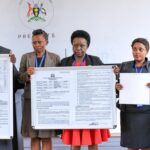
The document bears an official parliamentary receipt stamp under “Matters of National Importance,” signalling that the issue has formally been brought before Parliament for consideration.