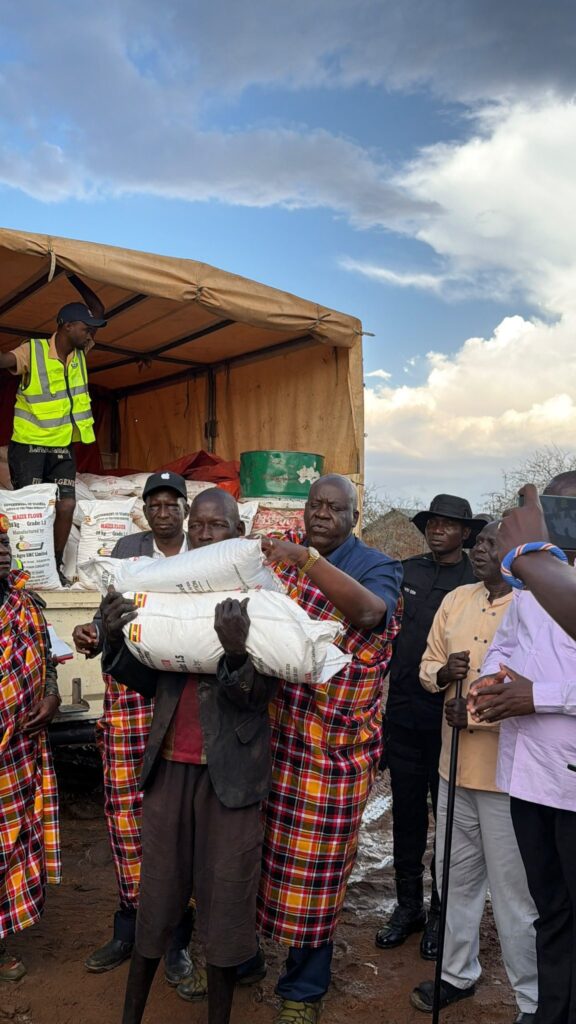

The Government of Uganda, through the Office of the Prime Minister (OPM), has delivered more than 1.4 million kilograms of relief food to vulnerable households across the Karamoja sub-region in the first week of its emergency food intervention, underscoring a coordinated national response to the worsening food crisis in the region.
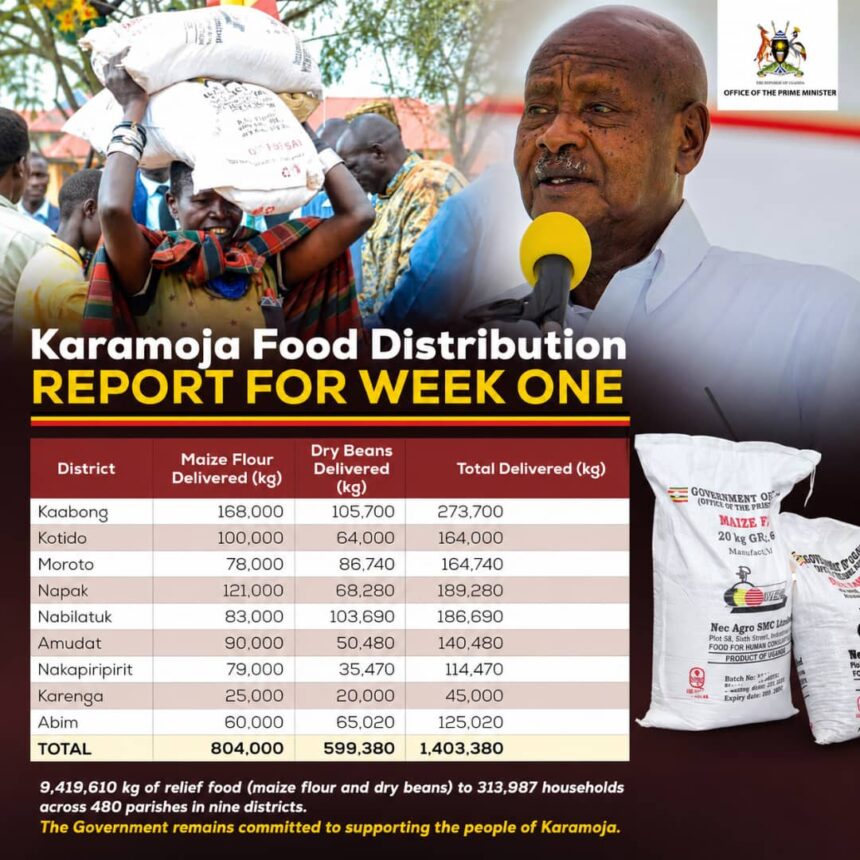
According to the Week One Food Distribution Report released by the Office of the Prime Minister, a total of 804,000 kilograms of maize flour and 599,380 kilograms of dry beans—amounting to 1,403,380 kilograms—were distributed across the nine districts of Kaabong, Kotido, Moroto, Napak, Nabilatuk, Amudat, Nakapiripirit, Karenga, and Abim.
Kaabong District received the largest share of the consignment, taking delivery of 273,700 kilograms, followed by Napak with 189,280 kilograms and Nabilatuk with 186,690 kilograms. Other districts included Moroto (164,740kg), Kotido (164,000kg), Amudat (140,480kg), Abim (125,020kg), Nakapiripirit (114,470kg), and Karenga (45,000kg).
The emergency intervention was launched following President Yoweri Museveni’s directive to release Shs45 billion to address severe food insecurity in Karamoja, where prolonged drought and crop failure have left thousands of households struggling to access food. Government figures indicate that more than 313,000 households across 480 parishes are expected to benefit from the ongoing exercise.
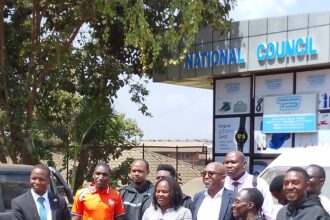
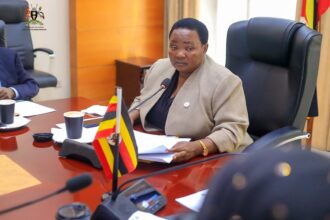
Prime Minister Robinah Nabbanja flagged off the relief operation at the National Enterprise Corporation (NEC) headquarters in Bugolobi, where she commended the Uganda People’s Defence Forces (UPDF), through NEC, for rapidly mobilizing food supplies and logistical support for the affected communities.

At the center of the operation is the National Enterprise Corporation, the commercial arm of the UPDF, led by Managing Director Lt. Gen. James Mugira. Under his stewardship, NEC has increasingly positioned itself as a key player in national development, particularly in food security, agro-processing, manufacturing, and emergency response initiatives.
Lt. Gen. Mugira has overseen NEC’s transformation into a strategic institution capable of supporting government interventions beyond its traditional military mandate. Through NEC Agro, the corporation has leveraged its production and supply chain capabilities to ensure that life-saving food reaches some of Uganda’s most vulnerable populations in record time.
Government officials have praised the collaboration between the Office of the Prime Minister, NEC, the Uganda Prisons Service, Uganda Police Force, and local governments, noting that the multi-agency approach has been instrumental in ensuring transparency and efficiency during the distribution process.
Speaking at the flag-off ceremony last week, Prime Minister Nabbanja emphasized that no Ugandan should lose their life to hunger and warned against the diversion of relief supplies intended for affected households. She further noted that NEC supplied food commodities at competitive prices, helping government maximize available resources while responding to the humanitarian crisis.
The Week One report provides an early indication of progress in what is expected to be one of the country’s largest recent food relief operations. With more than 9.4 million kilograms of maize flour and beans earmarked for distribution over the coming weeks, authorities remain optimistic that the intervention will stabilize communities and avert further hunger-related fatalities in Karamoja.
For many observers, the ongoing exercise is not only a humanitarian response but also a demonstration of how government institutions can work together to address national challenges. The partnership between the Office of the Prime Minister and the National Enterprise Corporation under Lt. Gen. James Mugira has highlighted the growing role of state agencies in delivering timely and impactful solutions to communities in need.
“The President does not want to hear of anyone in Karamoja dying of hunger. No one will be left behind.” — Hon. Sam Engola, Minister for Relief, Disaster Preparedness and Refugees.
As trucks continue to traverse the rugged terrain of Karamoja carrying maize flour and beans, the government’s message remains clear: every effort is being made to ensure that vulnerable families receive the support they need while longer-term solutions to food insecurity are pursued.